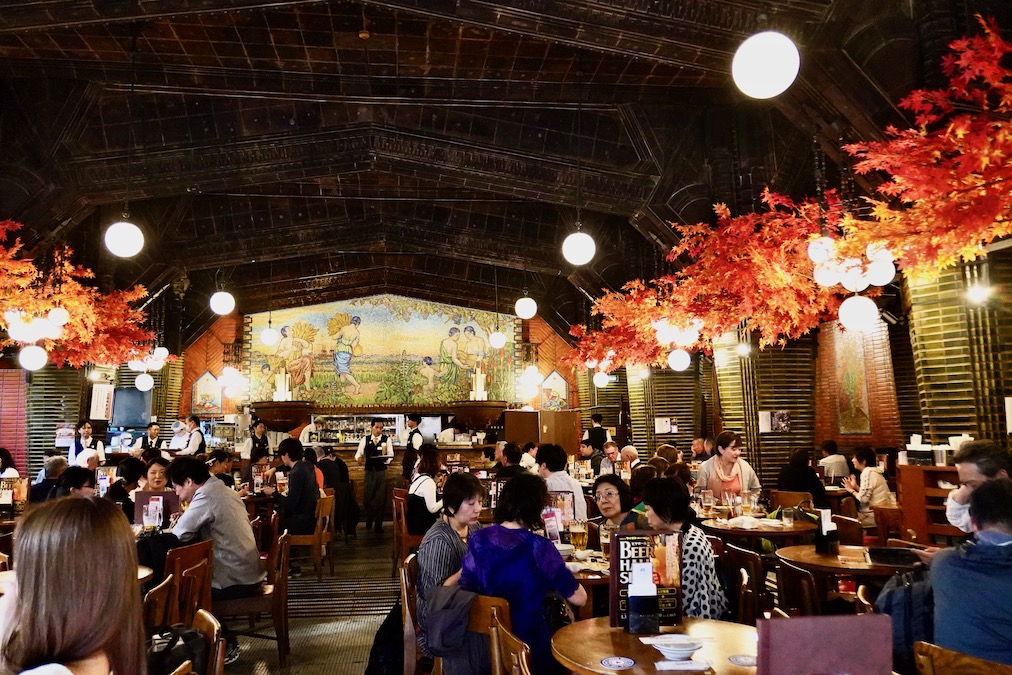
Am I kidding? Seeking out a German beer hall in Tokyo? In fact, I walked quite a distance from Kyobashi near Tokyo railway station, searching for the Lions beer hall run by the Sapporo Group in Ginza, because it is intrinsically Japanese and a masterpiece. A treasure.
Despite its deteriorating state, I found it a place of great beauty and fell in love with it.
Beer is believed to have been introduced to Japan in the 17th century by Dutch traders. Beer halls eventually were seen as a way to promote local Japanese beer. Today, the Japanese drink more beer than sake, and their major brands are known throughout the world.
Ginza, the upmarket area of Tokyo, has had beer halls since 1899. The Lions beer hall in Ginza is the oldest operating beer hall in Japan, heritage listed and registered as a Tangible Cultural Property of Japan. This, I had to see!
It took three years in the early 1930’s to complete the Beer Hall, designed by the famous architect Eizo Sugawara, who also designed the old Shinbashi Theater and worked with one of the most famous and influential architects of the 20th century, Frank Lloyd Wright.
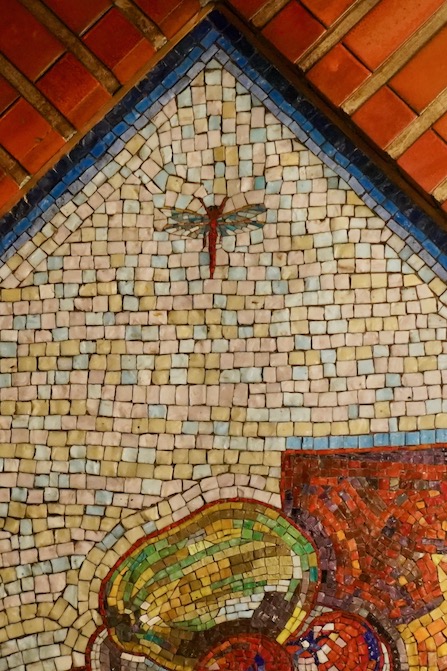
Sugawara used the finest artisans of the day for its decor in the Hall, including glass artist Yoshizo Okura who worked on the extensive hand made glass mosaics still to be seen throughout the Hall.
Twelve stunning glass mosaics of different sizes were installed throughout. Most are framed like paintings on the red tiled walls. The sketches for the mosaics were drawn by Sugawara, and he oversaw their production. Sugawara was stringent about colours and ordered several remakes. It’s a wonder he didn’t drive Yoshizo Okra mad! Ultimately, Sugawara agreed on over 250 colours that he was satisfied with.
In its heyday, the gigantic beer hall was very luxurious and innovative. I imagine it would have attracted the cream of society.
Essentially, it hasn’t changed since it opened. But it’s a bit like a great classic beauty in her old age. You can still sense the style and glamour, even if she has wrinkled, withered and deteriorated.
What you see today is pretty much what was presented to the public when the beer hall opened its doors in 1934 – almost 90 years ago. Of course, everything would have been pristine back then, in first class order. I have no doubt that both Yoshizo Okra and Eizo Sugawara would probably be bitterly disappointed in its upkeep in more recent years.


Preserving a Tangible Cultural Property in its original state is one thing. Allowing it to deteriorate is another. I do hope Lions and the Japanese Government consider a quality restoration by craftspeople before it’s too late.
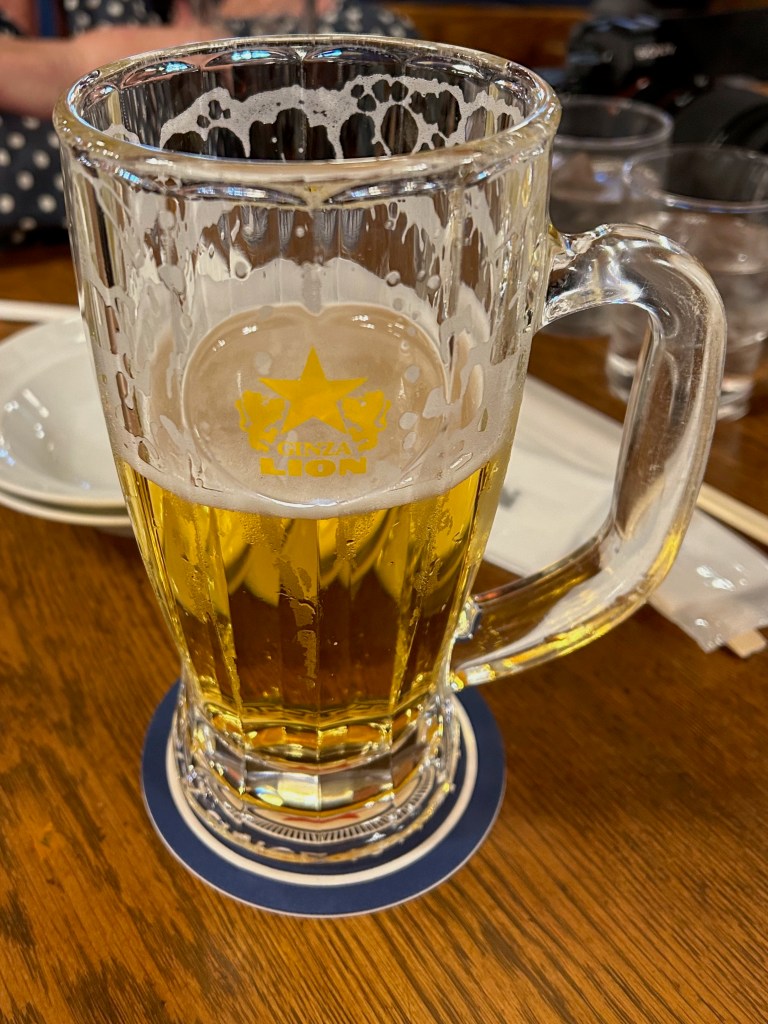
On the day we visited this last November, it was clear the Hall remains very popular. It was packed with a lunchtime crowd, and we were lucky to get a table as walk-ins. The menu is pretty much pub food – reasonable and not expensive. And, of course, there was chilled beer – plenty of it on tap from the Sapporo range.
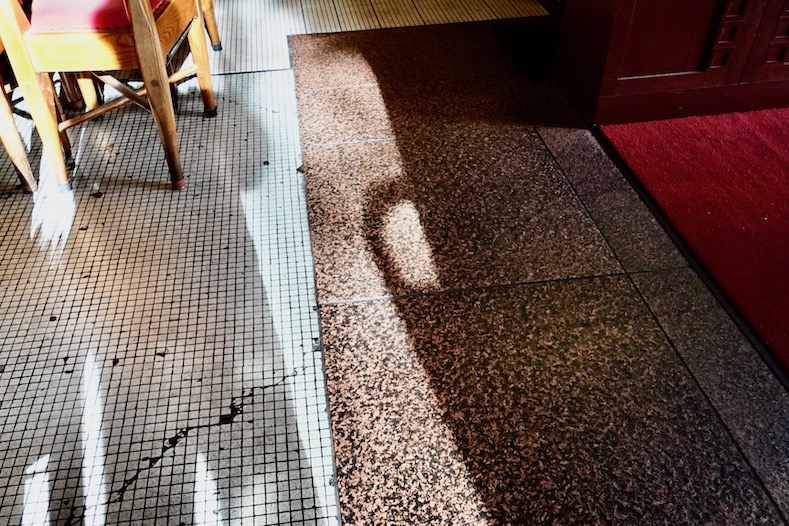
I wandered through tables of diners with my camera, photographing the various mosaics. They are largely in good order and wonderful to see. But tiles on the floor are cracked, pitted and broken in many places, and it looks like it needs a good steam clean.

The floors urgently need repairs


This is not a five star dining experience – the fare is reasonably priced average ‘pub’ food. You visit to experience the artistry, the charm and art deco elegance that still lingers. You can still appreciate what Sugawara, Yoshizo Okra and other leading artisans created.

The design concept is ‘fertility and harvest’. Behind the bar, a large glass mosaic mural showing women harvesting beer barley and grapes, remains impressive. An acanthus flower, symbolising love and peace, can be seen in the centre of the image. Two fountains were installed at either end of the counter. They don’t work these days, but they still frame the bar.
Red brick walls symbolise the ‘nurturing power of earth, while thick green pillars represent barley. Round pendant lights feature designs inspired by beer foam. I’m not sure what the artificial autumn leaves are about. They don’t seem to be a feature in the original design and to my mind, clutter the place.


Remarkably, the Hall escaped the bombing of Tokyo. In the most devastating raid on the night of 9-10 March 1945, 16 square miles (41 km2; 10,000 acres) of central Tokyo were destroyed, leaving an estimated 100,000 civilians dead and over one million homeless. In 1945, when the War was over, the Hall was reserved exclusively for the use by the AmericanExpeditionary forces. This ended in 1952, when it reopened to the public again.


I wonder what it was like to be dining in the Hall in the 1930’s? What conversations could be heard – perhaps whispered at some tables? The 1930s were a decade of fear in Japan, with a resurgence of right-wing patriotism, the weakening of democratic forces, domestic terrorist violence that included an assassination attempt on the emperor in 1932, and stepped-up military aggression by Japan abroad. Subsequently, in May 1932 the Japanese Prime Minister Inukai Tsuyoshi’s struggle against the military led to his assassination, effectively ending civilian political control over government decisions until after World War 11.

It was a decade of intrigue, political tensions and spies. It also was a time when peace activists, both within Japan, Europe and in America, were working hard to prevent war.

In 1934, a team of famous American baseballers, including Babe Ruth, toured Japan as part of that effort. I don’t know if they visited the Beer Hall in Ginza, but they did stay at an elegant art deco hotel on the coast near Nagoya, where I also visited in November. That’s another story coming up soon!
NOTE: Beer Hall Lion Ginza is open from 11.30am to 10pm from Sunday to Thursday (until 10.30pm on Fri, Sat and eve of holidays). It’s a three-minute walk from Ginza station. There is an English menu, and english speaking staff.Children are welcome – there are Child chairs available and a kids menu.
 Travelling Therese