
My first glimpse of an ancient Heian period Japanese pure land garden was a poster I spotted in Ichinoseki, a city in Japan’s Iwate prefecture. It showed people dressed in ancient garb, enjoying the outdoors by a pretty stream. The scene invited you in, evoking feelings of peace, happiness, relaxation and tranquillity. Heaven.
I had absolutely no idea where the park was, and I was not familiar with the heavenly concept of a pure land garden. I didn’t get my phone translator out to read what was on the poster, I didn’t know that it was advertising a festival in a pure land garden in Hiraizumi, Iwate in late May. Even if I had, it wouldn’t have meant anything. I hadn’t heard of Hiraizumi. I had no idea how close I was to it, or that within a few days I would be in this ancient pure land garden.

Japan is famous for its gardens. I’m familiar with zen gardens. But, until this trip, not Buddhist pure land gardens. They became popular In the late Heian Period between around 794 to 1185. The garden landscapes were built to resemble the concept of a Buddhist paradise. A pure land of Buddha, aspired to in the next life, along with peace of mind in the current life. These gardens usually feature a large pond with lotus flowers and islands, along with beautiful pavilion buildings.

The Heian period was a time when Japanese art and culture was developing. Apparently, no complete pure land garden from that time survives, but there are elements at Uji’s beautiful Byodoin Temple near Kyoto and more so at Hiraizumi‘s Motsuiji Temple. I have visited Byodoin Temple and loved it. But I didn’t realise its design was based on a pure land garden. And, now familiar with both places, I feel Motsuiji is more true to the concept. In Uji, the magnificent Byodoin Temple and tourist crowds dominate the surrounding garden, where-as at Motsuiji the buildings and the garden features blend in quiet harmony. Motsuiji gives me a greater understanding of a Heian period pure land garden.

When I spotted the poster, we were en route for a three day stay in the small nearby town of Higashiyama to see Geibikei Gorge. Researching possible day trips from our base, I came across Hiraizumi. I was attracted by the fact that it seemed very well set up for tourists, with a “Run Run” loop bus, a transport tourist service every half hour that connected the railway station to all major attractions in the town, including UNESCO World Heritage sites. Perfect!
Long ago, Hiraizumi was Japan’s northern capital, thanks to the discovery of gold and an innovative dominant leading family clan in the region. It became a cultural and political powerhouse that rivalled Kyoto, the then national capital of Japan.
Today, it’s a pretty back water regional town, its glory days well past. We were dropped off in the morning outside Hiraizumi’s railway station, and it struck us as incredibly quiet. Not another tourist or “run run” bus in sight!
A tiny tourist office in the station was open and staff informed us that the buses only operate on weekends and public holidays! Bicycle hires – both electric and pedal yourself – were available next to the station at very reasonable prices. Unfortunately, not an option for me with the gammy knee. Taxis were outside the station, but would one be available when you needed to return? Asking them to wait is an expense not in my budget!

The tourist office attendant said not to worry – we could walk to their two most famous temples, the gilded Chûson-ji or Motsuji. One was about 800 metres away and the other about 700 metres. In different directions. Our time was limited, so we decided to choose one – Motsuji – and then see how our time was going.
Did I mention the rain? Storm clouds were gathering as we hurried with our our brollies along a pretty main street directly from the station.
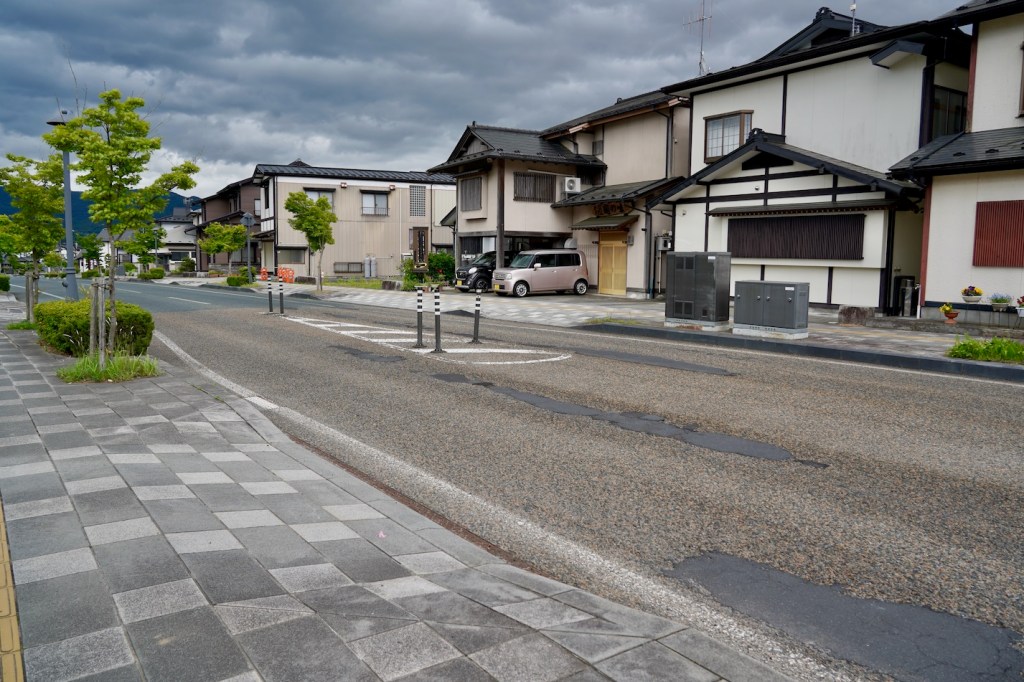
It was a pleasant walk despite showers en route. They eased off as we arrived at Motsuji’s entrance.
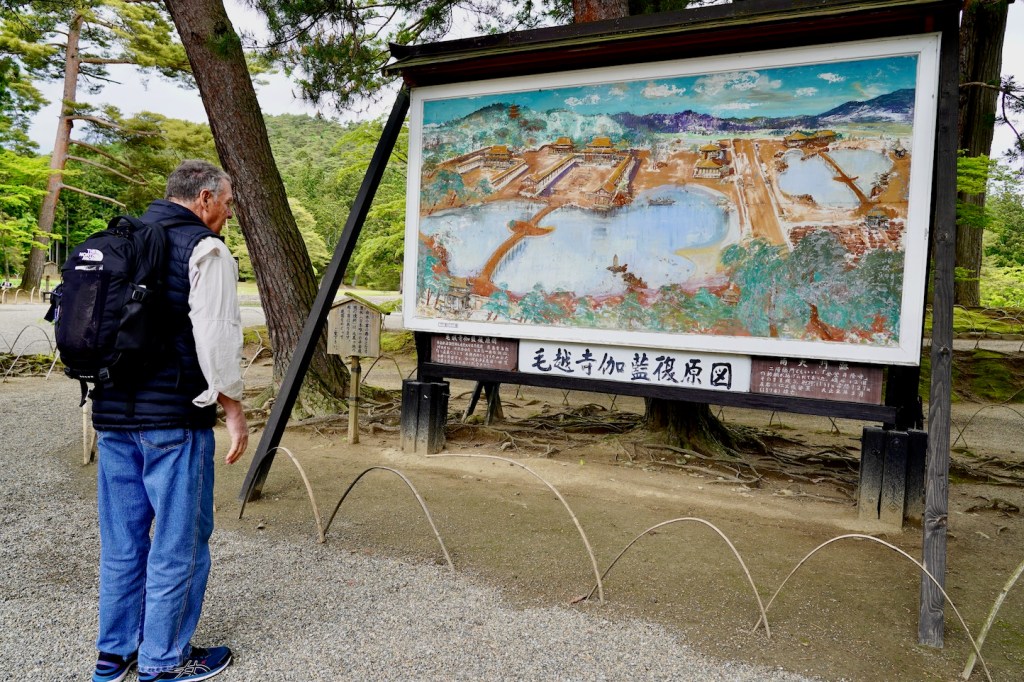

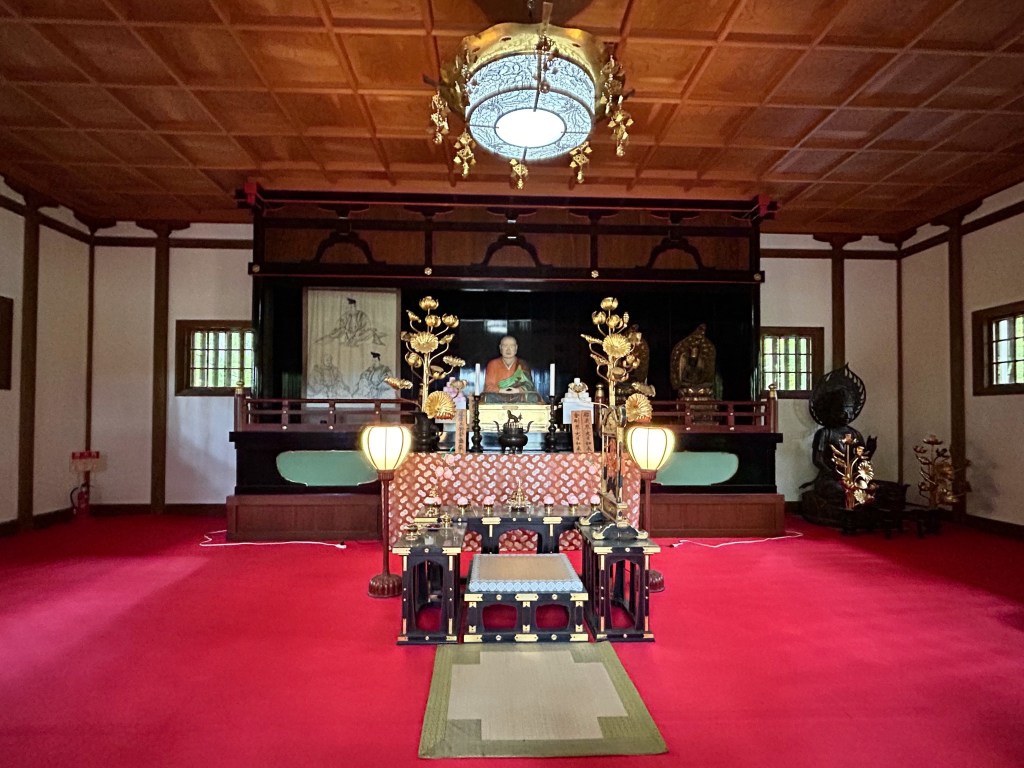
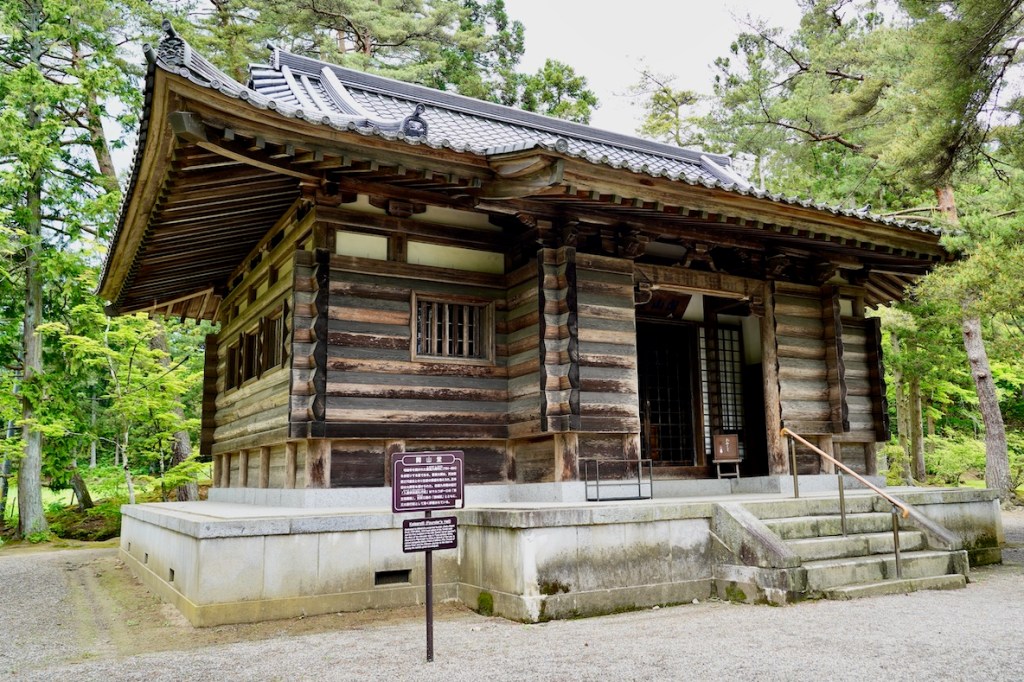
Admission to Motsuji is 700 yen per adult (May 2024). Under a dollar. There are various buildings of interest scattered around the grounds – including the Hondo, the temple’s principal hall, which looks ancient, but surprisingly is a reproduction completed in 1989 – a testament to the craft skills that survive in Japan today.
Mōtsū-ji was founded in 850, with most of its splendid halls built in the 12th century. At its peak, there were 40 temple buildings and quarters for 500 priests. Over time, all of the buildings were destroyed by fires, either by natural causes or in conflicts. But its Pure Land garden and the foundations of the Heian period temples were maintained.
Rebuilt halls today include Jogyoda. The original one burned down in 1597, with the current version built in 1732. So coming up to 300 years old.


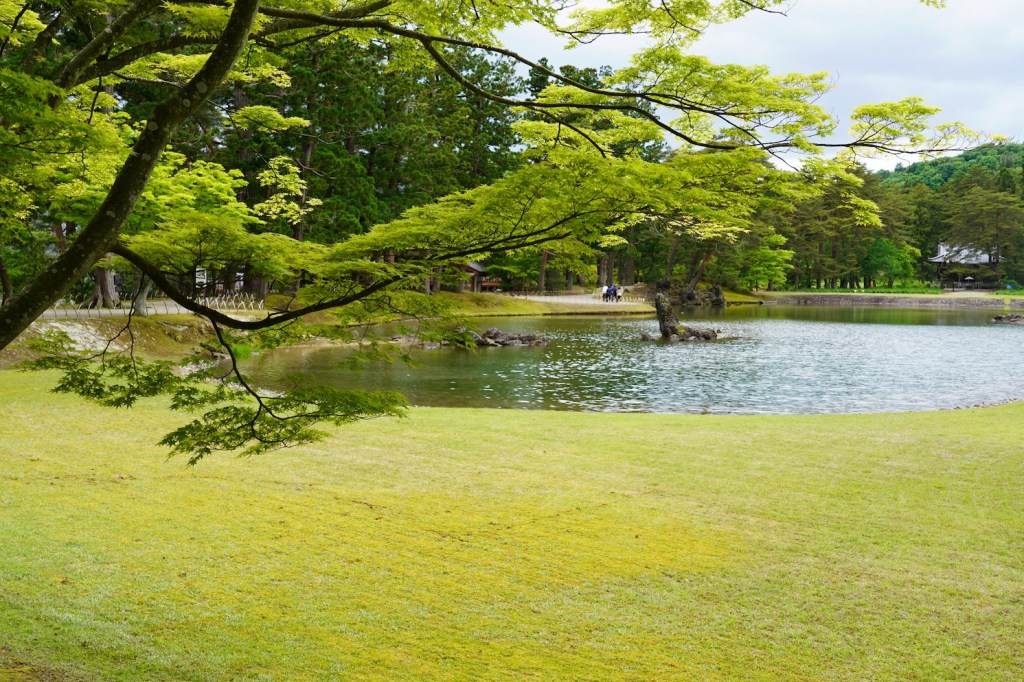
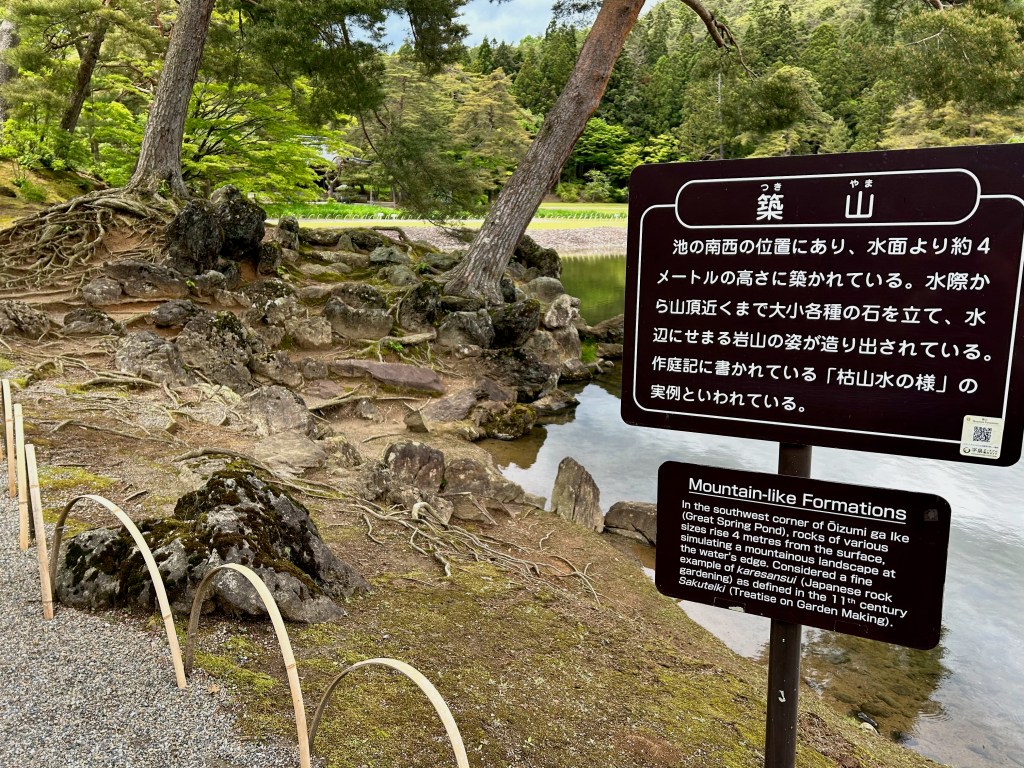
On entering Motsuji, I was immediately drawn to the sight of the woodlands to my right, and a large lake like pond, known as the Oizumi ga Ike. The garden design unfolds as you amble around the lake, with subtle elements to absorb such as a small peninsular beach area, little coves, a rocky coastline, majestic rocks protruding from the pond’s surface, bridges, and suggestions of mountains. Even a few golden dragon boats moored in the pond, and an old wooden boat lazily huddled by the shoreline. The boats could have looked wrong in this setting, but strangely they didn’t.


This is not a major flower garden, though there was a large cultivated bed of iris close to the lake. Its flowering season was over when I visited, but I could see it would blend with the garden’s idyllic nature character. Iris represents courage and good news. Its sword-shaped leaves symbolise a warrior’s spirit. There may well be a lot of spirits wandering around this place. I suspect they are happy contented spirits.
The various elements at Motsuji come together as a pure land – the principal hall, other buildings of interest, the gardens and lake/pond. It’s said the beauty of this garden has remained essentially unchanged for eight centuries, blending harmoniously with the surrounding trees to form what is regarded as an eternal landscape. And that indeed is what it feels like – that it’s been there forever, and is part of nature.
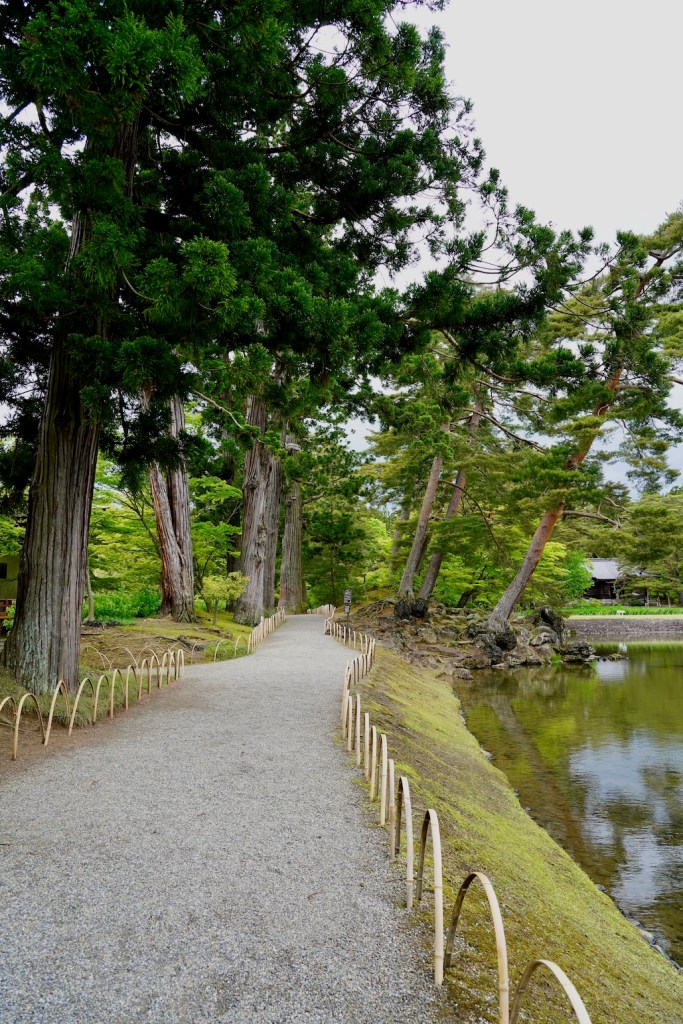
I read on a tourist blub that Motsuji “quiets the mind with its serene beauty”. This was no exaggeration. I was relaxed and at ease with the world as I walked around the lake. With an overcast cloudy sky for our visit, my photos fail to do justice to it.
Motsuji, founded in 850, has the only surviving feeder stream in its pure land garden from the Heian period. And as I walked around the lake, there it was ahead of me – yes, I suddenly realised I had inadvertently found myself in that poster garden, designed from Japan’s earliest garden manuals!

I was thrilled to recognise the little stream. It was buried underground for a long time, but has now been restored to its original state. Gardeners were quietly working on clearing weeds and preparing it for the upcoming festival advertised in the poster. A few tree loppers were hard at work trimming branches, like artists with a brush on canvas.

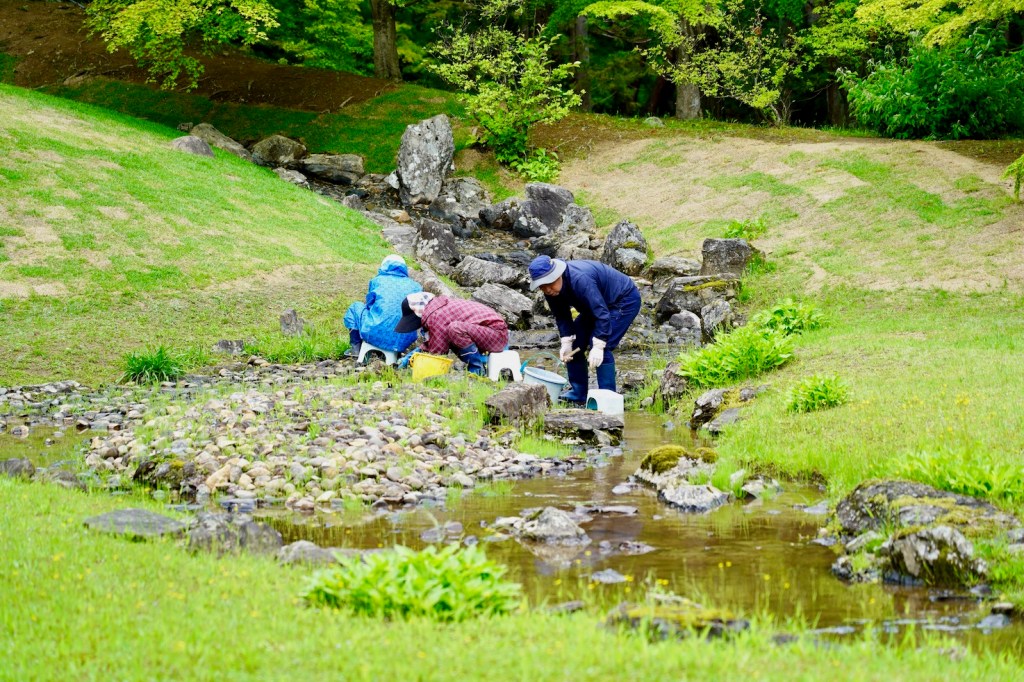

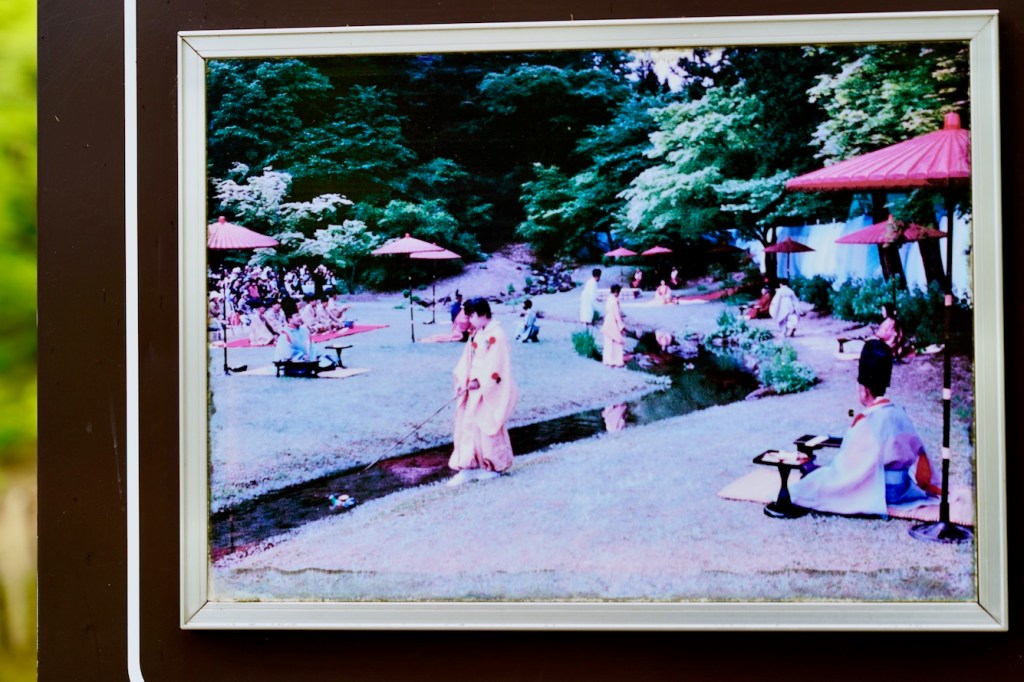
The spring festival is known as the Gokusui no en – the Floating Poetry Festival. It seeks to revive an ancient drinking and ‘waka’ poetry writing ceremony, generally enjoyed by imperial courtiers. People taking part dress in ancient costumes, and improvise short poems. After reading their verses, they drink sake from lacquered cups floated down the stream – presumably to gain further inspiration!
We should have picked up our pace so that we could have fitted in more of Hiraizumi’s famous temples such as the near by 850 built Chūson-ji. I had also wanted to see another unique old temple that had been built into a cliff face just out of town.
But we lingered, taking in the beauty and peace of this pure land garden. We didn’t want to hurry our visit for the sake of visiting another place.
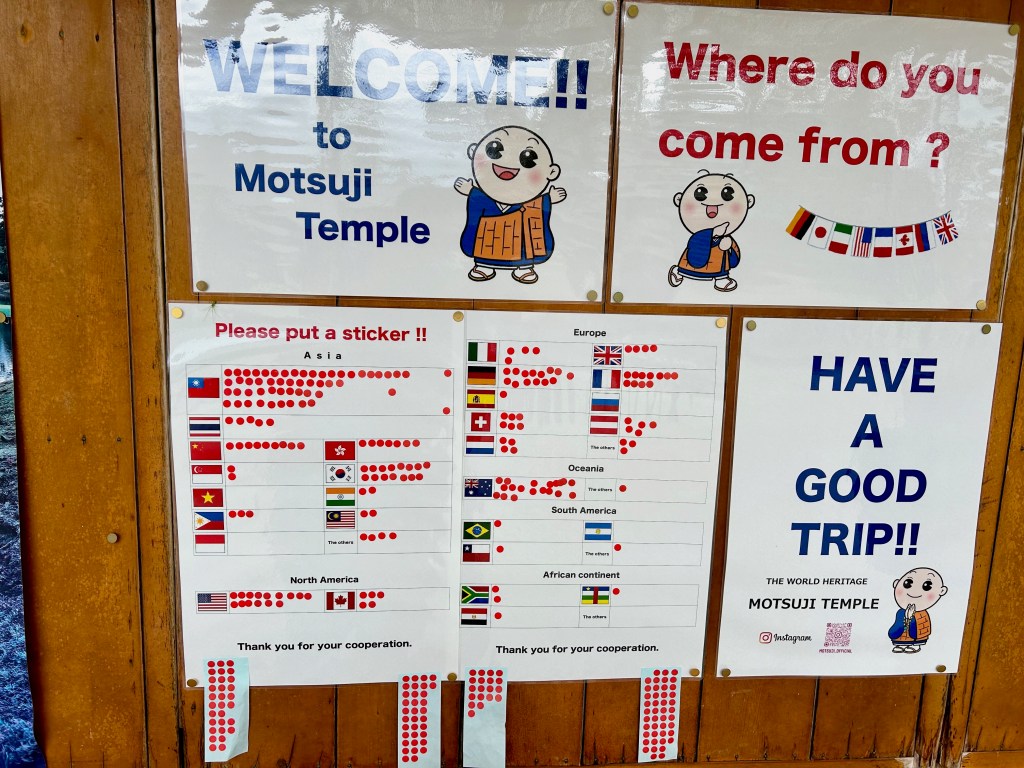
Morsuji invites visitors to record their home countries on a board near the Main Hall. Taiwan seems to be leading with the most visitors. The Australian flag represents Oceania – quite a stretch as Oceania includes more than 20 countries with their own flags. Others? Has to be New Zealand. No self respecting Kiwi would put their dot under the Aussie flag!
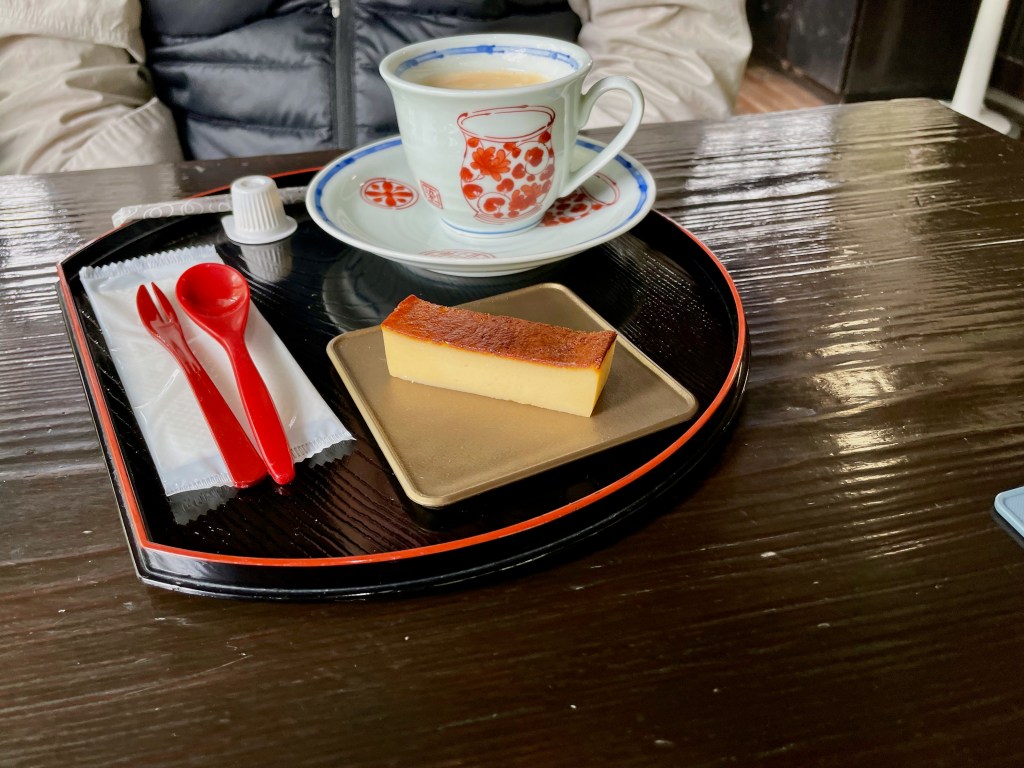
Near the exit/entrance is a small cafe called Shofuan, specialising in soba noodles and sweets. We decided on coffee and desert – MJ bought a cheesecake, and I bought ice-cream, with little filled biscuits and strawberry dressing. We were celebrating our good fortune in finding this very special pure land garden.

PS: Were the garden gods smiling on me after this pure land visit? Perhaps. As I was finishing writing this story, I received word that I’ve been allotted places for myself, MJ and a travelling companion to visit Kyoto’s famous 1600’s Katsura Imperial Villa on my next trip to Japan. It is one of the most significant gardens in Japan known for both outstanding garden and architectural design! It’s also a place extremely difficult to see without some luck on your side!
The villa grounds, covering just over 16 hectares, aren’t open to the general public. But with forward planning, there’s the possibility of joining a small group tour with an Imperial staff guide by applying on line or in person for a place in a ballot system. I haven’t been able to see Katsura on my many past visits to Kyoto. This time, I applied online months ahead – as soon as the ballot opened for my preferred date. The process seemed a lot more streamlined and easier than the last time I considered it. So something to look forward to on my next trip to Japan!

 Travelling Therese
Love it. I have always been fascinated by Hiraizumi. I find it amazing that such a powerful city could just about disappear with little trace of its former glory. I have been there 3 times. The first time was in 1989 as a college student. The professor, who had a background in Japanese art felt so strongly about Hiraizumi that he included it on the group tour of Japan.
I remember him telling us that because Kyoto has been burned down so many times, to see Heian Era architecture and art, you have to visit places like Hiraizumi.
The Northern Fujiwara who ruled the area in the name of the Emperor, nudge nudge wink wink, apparently intermarried with the local Emishi, who were not ethnic Japanese. The Emishi are thought to be similar to the Ainu of Hokkaido, but who they are is a bit of mystery. I find that intriguing as well.
LikeLike
That’s interesting about the Emishi. I thought some of the people in Iwate had a different look. Even Shohei Ohtani. We plan next year to base ourselves in Iwate and explore that regional much more. So we will definitely be back in Hiraizumi.
LikeLike
Look into the Matagi.
LikeLike
Very nice! 🙂
LikeLike
https://scitechdaily.com/who-are-the-japanese-new-dna-study-shocks-scientists/ thought you might be interested in the Emishi we talked about.
LikeLike
Extremely interesting.. I’ll need to read it a few times to take it all in..
LikeLike
Not sure if you got my reply re the Instagram – aussieboomer1 – Uji story good reading… visited last year and enjoyed very much. LOVED LOVED LOVED MATSUE. Only scratched the surface. Treated to wonderful sunset last night. Heading for Kyoto,. Will be writing up the trip on my blog over Xmas/New Year
LikeLiked by 1 person
Looking forward to it.
LikeLike
we have explored a little around Lake Biwa on previous trips. Only in Kyoto for two days this time to catch up with Japanese friends made on previous visits, and to visit the Imperial Villa. We secured tickets! Hardly seeing any western tourists so far on our trip – mainly because we have largely been off the usual tourist track – groups of Chinese tours occasionally, but our friend travelling with us on her first visit has been asking where is this over tourism lol! For some reason when travelling my instagram photos will only post up in a restricted size – not the original size.
LikeLike
There is a bamboo grove fairly nearby. One stop from Katsura station. Higashimuko Station. Looks like Arashiyama, but I hear its not crowded at all. Called “Take no michi.” I have wanted to see it myself. https://www.kyototourism.org/en/sightseeing/565/ Although i am sure you are fully booked for your stay in Kyoto.
LikeLiked by 1 person
I know where it is. I was taken there by a Japanese friend on a previous visit. Unfortunately, it was closed, so I didn’t see inside. But walked around part of the perimeter, and definitely looked worth visiting. My Japanese friend said tourists didn’t generally know about it. I have been up to Arashiyama, liked the town – but thought the bamboo forest a bit too touristy. Have seen much thicker bamboo forests travelling around Japan. We stay in a fairly quiet, but interesting area walking distance from Gion. Like night and day re the two areas. One soooooo busy, the other much nicer. En route on the train now to Kyoto. Really impressed with Matsue, and hope to return one day to explore more of the prefecture.
LikeLike