I noticed people are reading this story that I posted back in 2021. Taking another look at it myself, I decided it needed an update. So .. here we go again!
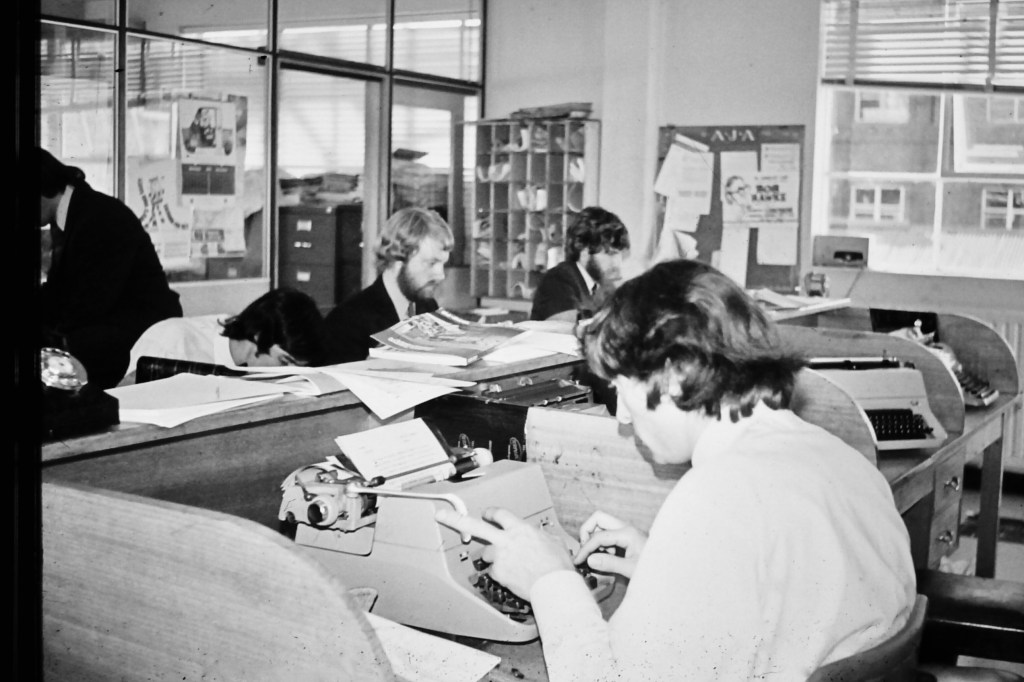
The photo above is one I took of my first newsroom when I began my career as a broadcast News Journalist with Australia’s ABC in the early 1970’s. We were called Press, not Media. Which was a bit silly for Radio and Television Journalists. We worked in radio and television news, not newspapers or magazines. I was based in the ABC’s Hobart newsroom, receiving some training in Sydney, doing relief work in other Tasmanian newsrooms, and eventually working in ABC newsrooms in Perth (WA)and Adelaide (SA).
When I joined, we still were expected to sound a little ‘British’ when reporting on air. But times were changing, and our natural Australian accents soon became the norm. After going to elocution lessons for some years to perfect my ‘clipped British accent’, I had to revert to my own Aussie accent without too many wide vowels.
I was fortunate to start in this newsroom. There was a wonderful team of people there and we had several Journalists with extensive overseas experience, including a few former War Correspondents, and they were wonderful mentors.
The photo was taken with my Pentax film camera, and it shows the reporters’ room. Check out the heavy, clunky ‘dial with your finger’ black telephone to the far left. And manual typewriters! I think some of the secretaries and news typists had fancy electric ones!
You’ll note the reporter closest to my camera is manually ‘returning’ his typewriter to type in the next line. The AJA (our union – the Australian Journalists Association) notice board in the far background has a note with a caricature drawing of Bob Hawke, then the president of the Australian Council of Trade Unions and destined to be a popular Australian Prime Minister. He was visiting Tasy, and the note would have indicated the time, place and date of his appearance as guest speaker at one of our Journalist Association luncheons. I would interview him a few times later in my career.
Bits and pieces of paper are strewn about in the photo.We had to carbon copy several copies of each story we typed, and a copy would go to various people in the newsroom including the sub-editor and the Chief of Staff. A lot of trees were probably lost to news stories in those days.
When a Journalist’s story was chosen for a bulletin and edited by the sub editor’s pen, it would then be retyped and again carbon copied by our professional typists for the news reader. Most of the male Journalists were self taught typists – some two finger typists. I had been fortunate enough to properly learn touch typing at school. My Dad knew I wanted to follow his footsteps into Journalism, and insisted with my school that I do the typing classes. Typing wasn’t in my educational stream, so Dad devised a special school timetable for me and convinced my teachers to allow me to do it.
My English teacher was horrified at the thought of me becoming a News Journalist, warning me I’d be entering a den of rough drunken men! She probably read a lot of Hemingway, but didn’t approve of his lifestyle. She warned I would end up an unmarried alcoholic, probably with a bad reputation! I don’t think she knew Dad was a Journo! She advised I would be better placed with a career as a school teacher! Far more proper for a young lady in the early 1970’s. She was determined to save me from this undesirable future in Journalism, but failed. I pay homage to her excellent teaching skills and her ability to inspire confidence in her students. Without her, I may not have become a Journalist.
I joined the ABC newsroom at 18. I didn’t become a drunk and I did find myself a rather terrific husband, still my partner today. But my teacher’s fears stayed with me for a long time. I remained a tee totaller for the first several years of my career, and on the very rare occasions I joined other Journalists at the pub, I would only drink a raspberry cordial! Even when I did start partaking of alcohol – a glass of cola with one shot of Southern Comfort – I only indulged with close friends, and maintained my strait-laced teetotaller image with other Journalist for years. Now, in my ‘70’s, I remain a light drinker – a very occasional white wine, a glass or two of Japanese sake with a meal, or a small shot of my annual batch of home made lemoncello!
Journalists were working with tape recorders, but still mainly relied on shorthand in the early ‘70’s. The tape recorders when I started were massive – like a small suitcase and reel to reel that you edited by physically cutting the tape and rejoining with a type of white sticky tape.A job that I always thought was akin to craft work – something I was not good at. The tape recorders were very heavy to take out in the field reporting. Much too heavy for a tiny whisp of a girl – but I would never admit my weakness and somehow managed to haul these gigantic tape recorders around. Good training for backpacking and travel luggage on my travels! Thankfully, the ABC equipped newsrooms with the latest light weight cassette tape recorders soon after I began my career. Wow, what an innovation – we thought they were terrific!
I was a fairly shocking shorthand student. As part of my Cadetship, I had to undertake weekly shorthand classes. I clearly didn’t have a brain for it. And that was a concern as to graduate from my Cadetship and achieve my grading qualification as a Journalist I had to pass a shorthand test. Fortunately, the test was managed by my News Editor. He looked at the results of my test, and passed my effort. I don’t think he could comprehend what I had written, and didn’t want to admit his failure. I know that what I read back to him was nothing like what I’d noted down in shorthand in the dictation test. Luckily for me, tape recorders soon became part of a broadcast journalist’s equipment, and I really had no need of shorthand in my career.
The Internet, iPads, digital cameras, mobile phones, zoom chats, social media and all our modern technologies today were still a science fiction to us. We did have a computer in the ABC building – well, a massive computer system full of flashing lights and switches, housed in its own big room and attended to by technicians. I’m not quite sure what it did – nothing to do with the newsroom though. News from the rest of the world arrived by telephone or a massive and very noisy telex machine that had its own special ‘telex’ machine room.
News from Tasmania didn’t reach the rest of the world easily. We were largely unseen – and unheard of, unless you counted the Tasy Devil cartoon character TAZ, made popular by the Americans. Then, in 1967 a massive out of control bushfire (wildfire) raged through the capital, Hobart and nearby towns, resulting in 62 lives lost, 900 injured and over seven thousand homeless. The Hobart newsroom was unable to directly report interstate on developments on the fire front because of some communication failure. But it could send reports to the northern Tasmanian Launceston office, where my Dad was based, and that news was then relayed onto the mainland newsrooms to tell the world.
Something clearly got lost in translation. A major Irish newspaper, reporting on the fire, led with a front page story of the whole of Tasmania’s population being evacuated on a submarine! Would that be all 375,244 of us? It provided a laugh in what was a very tough week for southern Tasmania.
In the far distance of the newsroom photo above are our ‘pigeon holes’ where letters, notes etc would be left for various people in the newsroom. We each had our own pigeon hole. Note the old radio sitting on the window ledge. Just below it, you can make out a small pencil sharpening machine!
All the Journalist blokes then were quite formal, wearing suits and ties. Being the ‘70’s, some suits were rather colourful, and they were allowed to follow the current fashion trends with beards and long hairstyles. There was no dress code established for ABC women Journalists because there were so few of us.
However, I was reprimanded by my News Editor one day for daring to wear a very formal designer black pants suit. Slimline trousers with a lovely matching jacket. It was beautifully cut, and designed by one of Australia’s most expensive top labels. I wore it with an ivory silk blouse, tied in a ribbon at the neck. I probably was wearing the most expensive and, dare I say, stylish outfit in the newsroom! However, my News Editor was shocked, and told me I should not wear a pants suit at work. It was not acceptable.
So, the next day in protest, I tucked my silk ivory blouse into a long black fine merino wool skirt that flowed down to my black leather booted feet. I’m sure I could hear a sharp intake of breath from my disapproving news editor when he saw it, but he puffed away on his cigarette and didn’t comment.
I wore the skirt endlessly in the newsroom for about a week, then tried out the pants suit again. I had paid too much for it to have the outfit linger in my wardrobe. No objections from the News Editor this time. He must have decided my designer outfit was preferable to the ankle length flowing skirt and boots.These days I look at the outfits worn by women Journalists and News presenters and smile. My outfits were so demur in comparison.
Most of the Journalists and our newsroom female group of typists (production assistants) smoked, and in those days they would endlessly light up their cigarettes and tobacco pipes in the newsroom. From some, there was even a little whiff of marijuana left on their clothes from the night before! In the Tasmanian winter it was freezing outside, so windows were kept closed. There was no air conditioning, so the newsroom would be quite a smoky den. I didn’t smoke and wore contact lenses. So the smoke bothered me on a couple of levels. I hated smelling cigarette smoke, and in the news room, I would get tearful painful eyes that would, in turn, affect my lenses. I would often walk around the newsroom, flinging open all the windows to clear the air, but others would quickly follow me to close them. I was always relieved to leave the newsroom on an outside reporting job.
We only had three female Journalists for the ABC in my home Australian State of Tasmania when I began my cadetship. And only two of us working in the field as reporters. How things have changed!
In the field, we had no mobile phones. They didn’t exist. So, if you needed to phone in a story you had to find a telephone box or ask to use someone’s home phone! Once, I was sent out to cover an uncontrolled fire blazing at an old people’s home. As firemen continued to evacuate the residents, I phoned in a story from a telephone box for the upcoming radio bulletin. The sub editor asked me for details I hadn’t been able to get with the emergency still underway. “Well, get in there – interview the firemen inside and the residents waiting to evacuate,” he ordered. “You mean, go into the blazing building,” I asked incredulously. “Yes, only if you think you are a real reporter!”
So, somehow, in the panicked confusion outside the home, I got past police and fireman into the burning building. And did as I was told – moving slowly up a stairwell with my tape recorder, as firemen and evacuees were coming down. I got some good interviews, didn’t meet a blazing end to my career, and returned to the phone box with my story. Later, I found out the sub editor was drunk! I should have known. He had a reputation for being able to work appearing quite sober, while actually quite insanely drunk.
During a national Government election, he was working as a key sub editor and was supposed to send copies of completed election stories to one of our senior journalists reporting results live on radio in a studio a few floors down from the newsroom. For some time, nothing was arriving in the studio, and dear Chris – a genteel old Englishman – kept sending messages up to the newsroom querying why updates weren’t being fed to him. The sub editor would send back a messages essentially saying ‘Chris, you’ve got everything we’ve got – there’s nothing new’.
Chris’s political commentary was drying up fast on his live broadcast, and he was filling in with chit chat for a good hour or two while desperate for something new to report on the election results. Eventually all was revealed. The sub editor had been accessing a stash of alcohol and again was quite drunk. He had been sending copies of all stories to Chris’s personal pigeon hole amongst those pigeon holes you can see in the photo above – instead of to Chris in the studio.
If you were on a television job with an camera crew and using an ABC car in the early ‘70’s, you had a two way radio to use – and had to say ‘OVER’ constantly during a conversation back to the newsroom. My television chief would refuse to answer me on the two way radio unless I said ‘over’, even though she could hear me clearly. “Hello Miss Gregg, hello, can you hear me?” I’d say. “She won’t answer unless you say over,” the cameraman would advise. Back then, all senior staff were addressed by we junior mere mortals as Mr, Mrs, or Miss.
I was once doing relief duty in the Launceston office (Tasmania) and we had an urgent news film to get to Hobart for that night’s news. But we’d missed the plane to get it there. So I had to go out to the main Highway and flag down a motorist, asking him to please deliver the film to the Hobart newsroom for us. The Cameraman thought I’d have a better chance to get a motorist to stop than him! It was delivered in time to be edited for the 7pm television news.
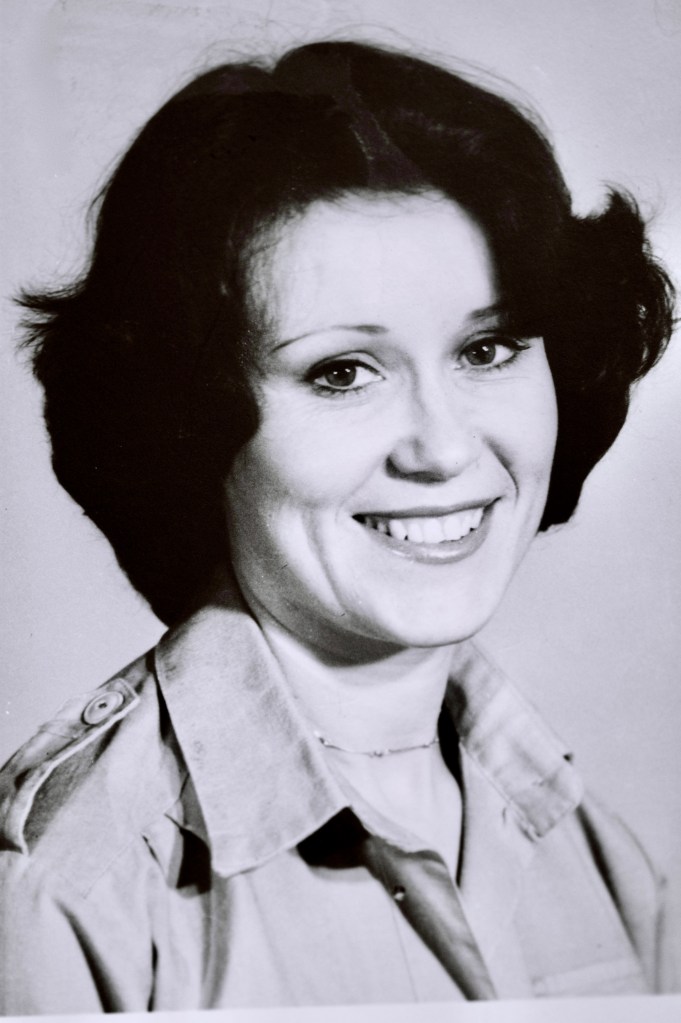
The photo below was taken professionally for my ABC Journalist Police Pass when I was about 24. The newsroom had arranged an appointment for me to have it taken early on my day off. But I forgot the appointment, and only remembered it 15 minutes before I was due at the photographer’s studio. I was about to leave home for a day’s bush trek on Hobart’s Mount Wellington, and I had no time to change. I was dressed for bushwalking, with an old frayed blue girl guides shirt, worn with a pair of khaki wool Australian army cadet trousers – both bought at an op shop. My feet were clad in two pairs of what were known as ‘pink and whites- pure wool Tasy made socks in big wide clunky Tasmanian Blundstone leather walking boots. I was a member of the Tasmanian bushwalking club, and spent many of my off duty hours trekking in the bush. The News Editor would have been shocked had he known what I was about to be photographed wearing.
There was no time to style my hair, so I quickly tossed my head forward, hurriedly brushed my hair through and tossed it back! I added a necklace to upmarket the look. With the clock ticking, I quickly whacked on some eye make-up and lippy – my grandmother always said ‘a little bit of powder and a little bit of paint makes a girl what she ain’t’. In this case, an op shop dressed bushwalker trying to look like a glamorous television and radio reporter. Then I raced for the studio in my little battered old VW bug – luckily I was only a five minute drive away. I was probably the most unprepared subject for a professional portrait shot the photographer had ever seen. But he worked magic, and it turned out quite well, don’t you think! As did my career.
PS: Tasy devils really do exist. I once had one howling outside my tent pitched for hours at night at a remote bush area of Tasmania. They have the most blood curdling, frightening howl. Needless to say, I never slept that night, and have never been a fan of Tasy devils since.
PPS: I’ve just heard that the building that housed the ABC newsroom in the 1970’s is soon to be demolished. The ABC moved out long ago, but for me it has so many wonderful memories of the people who worked there and the many stories we worked on. It was a wonderful time in my life, and remember the newsroom with much fondness.
PPPS: A journalist I worked with in the Hobart newsroom – Peter George – a year my senior – went on to become an accomplished overseas news correspondent. Last month – July 2025 – he was elected as an Independent member of the Tasmanian State Parliament. A new career! Inspiring! I guess I should keep trudging along – travelling, embracing new experiences and writing my stories.
 Travelling Therese
Great story! We must of a similar age. 1953 here.
LikeLike
1952! BABYBOOMERS! Communication these days is remarkable. Currently on the drive from Perth back to our small coastal town (hubby driving). And here I am almost directly chatting with you! My father was a Journalist like me. How he would have loved today’s communication abilities.
LikeLiked by 1 person
True but there was a certain charm of the old days and having to wait for the rotary dial of the telephone…..
LikeLike
I recall my parents ringing my paternal grandfather in London when I was about 4 years old. Months of planning went into the call which had to be made from home through our town switchboard operator. I think the whole town knew and was excited about this overseas call! I found out much later that my grandfather did not have a phone, so it was arranged for him to wait at a neighbour’s house to receive the call. My father had left England after WW2, and though father and son were on excellent terms and wrote regularly, they did not expect to ever see each other again given the distance and travel costs then. My grandfather, who passed away soon after, wrote a letter which I still have where he says he never thought he would hear his son’s voice again and how wonderful it was to speak with little Therese. He urged me to look after my baby sister.
LikeLike
unless.. you are in Afghanistan in the 1970’s, trying to ring through to your home in Tasmania – and you are put through to a switchboard operator in Paris who insists there is no such place! I asked to be put through to an operator in Melbourne, who put me through to my mum and dad in that place that did exist lol! That whole operation took over an hour!
LikeLiked by 1 person
Times have changed haven’T they?
LikeLike
Definitely..lol
LikeLike