
When most visitors to Japan think of the country’s ancient people, they usually focus on the Samurai period. But the Samurai were pretty much the new kids on the block. Japan has been inhabited by many different groups, and for me one of the most fascinating are the Jomons, believed to have lived in Japan for 17,000 years! Now, it’s true – they did not invent ice cream! They were, however, great potters, and one of their most famous Jomon images now grace ice creams you can buy at one of Japan’s most significant Jomon sites – the “World Heritage’ Sannai-Maruyama Historical site in Aomori on the northern coast of Honshu. I included my Jomon icecream photo to catch your attention! It was, by the way, delicious.


Without any doubt, the Jomon were great potters, and one of their most famous images now grace ice creams you can buy at one of Japan’s most significant Jomon sites – the “World Heritage’ Sannai-Maruyama Historical site in Aomori on the northern coast of Honshu.

Sannai-Maruiyama is Japan’s largest historical site that includes the remains of human settlement from approximately 5500 to 4000 years ago. The site was registered as a national historic site in 1997, and was amongst Jomon Prehistoric sites in Northern Japan registered as World Heritage in 2021.
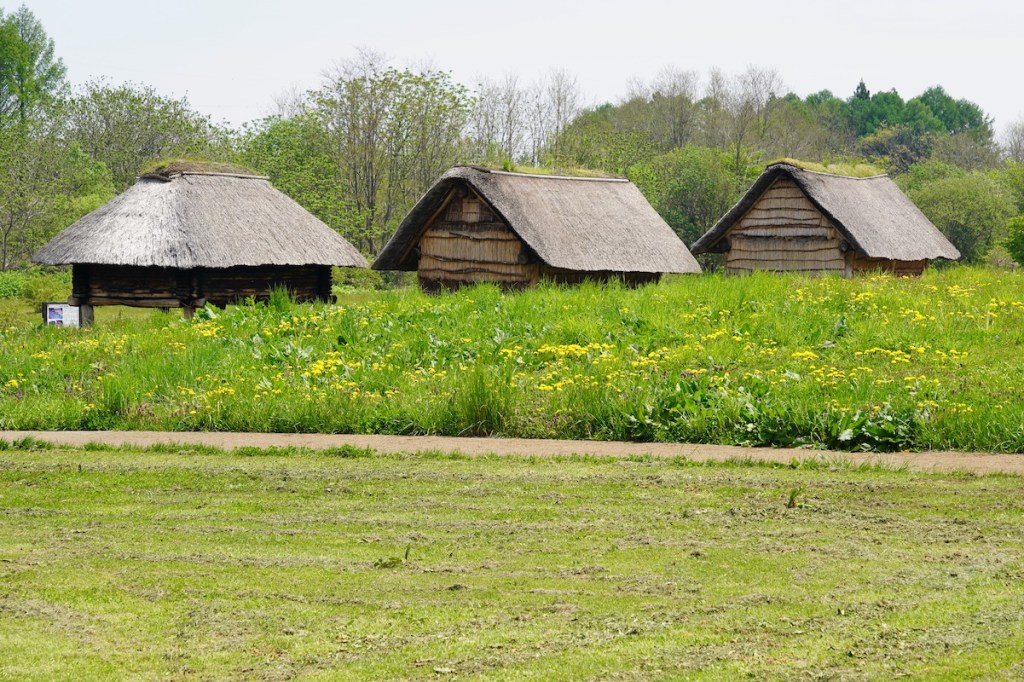
Although the site has been well known since Japan’s Edo period, it wasn’t until 1992 that archeological excavations began. The site, open to the public, now features several pit-houses and stilt-houses unearthed since then. What you see at the site is the evolution of their building techniques over time.


About 30 graves have been found to date, with an oval stones arranged in an arc around a hole dug in the ground. The bodies of children were buried in pottery vases. More than 800 have been discovered to date.

More than 550 pit buildings have been discovered, and 15 of them reconstructed for public viewing. Large pit buildings have also been discovered, reminiscent of long houses seen in other areas of Asia. It’s believed they were meeting halls, workshops or communal winter houses.


Excavations are still ongoing, and have uncovered well crafted earthenware and stoneware artifacts, some composed of jade and skilfully created lacquer. Other pieces have been made from bone, deer antlers and wood.


There are various theories about where the Jomon came from – one has them originating in South East Asia, another has them from north eastern Asia. They were descendants of the Palaeolithic inhabitants of the Japanese archipelago – hunter gatherers, fishers, and the world’s first known potters. Academics also suggest they were the ancestors of Japan’s Ainu people.


Studies and theories continue, but for visitors to Japan who want to get a better picture of the Jomons head to Aomori, where archeologists have been hard at work on a Jomon site and have recreated a village of Jomon buildings from the various periods of their existence in Japan.

The Sannai-Maruyama Historical Site is within the Jomon Jiyukan (Park Center), and visitors can view artifacts from the excavation site. Visitors also can try their hand at craftwork inspired by Jomon culture.
I went there in May this year (2025), and gained a real feel for Jomon life wandering around the site that features the remains of a large long-term Jomon settlement from the early to middle Jomon period (3,900-2,200 BCE).
I was a bit puzzled by a number of covered modern buildings, until I realised they covered and protected archeological digs. Most are open to the public.

It’s only a 20 minute public bus ride from the centre of Aomori – very easily accessible. And there is an abundance of information with signage and brochures in English, Chinese, Korean and Japanese. There are free guided tours of the site, but they are only in Japanese. However, it’s very easy to find your own way around.


There is a museum within the adjoining Jomon cultural centre that features approximately 1,700 artifacts including around 500 important cultural properties excavated from the Sannai Maruyama site. There is also a video theatre that introduces the site. If you want to watch the video in English, borrow an audio player from the information desk.

This is very much still an active archeological site where graves, the foundations of buildings, pottery and stone artifacts discovered at the site provide an insight in the settlement as it progressed over the centuries.
It’s worth checking opening hours, but generally the site is open to the public from 9am to 5pm – with later hours to 6pm during Japan’s Golden Week and the summer period from June 1 through to September 20th. There is a souvenir shop and a cafe. Personally, I would avoid busy times (weekends and holidays) as a less crowded site adds to the pleasure of wandering around the village. There is an admission fee, but when I went it was only 500 yen for an adult, and 250 yen for University students. High school and younger were free.
There is a picnic area, and an indoor cafe where such delights as Jomon chicken curry and Jomon icecream are on the menu. I doubt these resemble what the Jomon ate, but I tried both and they were tasty!
So what happened to the Jomons? It’s believed they were replaced gradually by the Yayoi people who arrived in Japan from the Asian mainland, around the 4th century BC. That’s another story.
https://sannaimaruyama.pref.aomori.jp/english/
AOMORI City is a very pleasant place on the Pacific Ocean’s Mutsu Bay. Both the city and Aomori prefecture offer visitors a lot to see, with good and inexpensive bus services to its sights. The city can easily be reached by the Tōhoku Shinkansen on Japan’s main island of Honshu. We stayed five days in May, and barely touched the surface. Stay tuned for more stories on Aomori.
See more of my photos on my Instagram: https://www.instagram.com/aussieboomer1/
 Travelling Therese
What a fascinating dive into the world of the Jomon people! I love how you captured not just their impressive pottery and structures, but also the sense of continuity at the active archaeological site. The Jomon ice cream photo was a clever touch! Thanks for taking us along on this historical journey—I’m already curious to read your next story about Aomori.
LikeLike
Thanks. Definitely more too come!
LikeLiked by 1 person
Beautiful place. Very interesting post.
LikeLiked by 1 person
Very beautiful area of Japan ..we’d like to go back and explore the prefecture more. Some more stories/photos about our visit last month to come…..
LikeLiked by 1 person