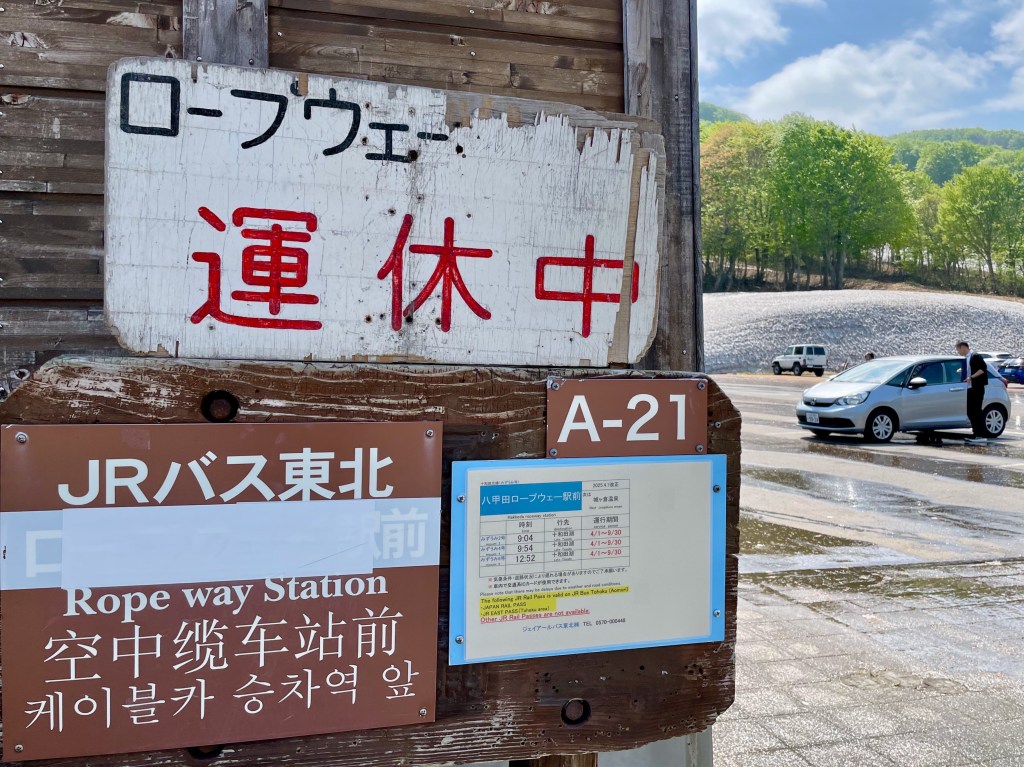
A fairly empty car park should have alerted us that something was amiss when we were dropped off by a Japan Railways bus at the Hakkoda Ropeway, in the Towada-Hachimantai National Park, about an hour’s drive from Aomori on Honshu.

We caught the first bus of the day there – an early bird approach to get ahead of other visitors. Our plan on this gorgeous spring day was to ride the cablecar up Mount Tamoyachi to enjoy the superb views offered by the 2.5km Hakkoda Ropeway of the extensive Hakkoda Mountain Range. On a clear day you can apparently see to the northern island of Hokkaido!
I’d read the summit featured wetlands -ponds and marshes, a variety of alpine plants and a range of trails for trekkers of all levels from a 30-minute walking path to a challenging 4-hour climbing course. Best of all, there is a restaurant on the summit – morning tea/early lunch!

What could go wrong! Winds on the mountain top, that’s what! Ropeway operations were suspended indefinitely – and the operators weren’t hopeful of a start up any time soon. As we were being informed of this, we realised our bus had already disappeared up the road heading towards Lake Towada, its main destination more than an hour and an half away. It wouldn’t return to take us back to Aomori until mid afternoon! We were stranded in the middle of nowhere – with just lollies and ice-creams in the base station’s tiny kiosk and the availability of a loo. What more could you want!
Should I have checked the ropeway status before leaving Aomori? I would have if the English version of its website was working. It wasn’t, and now – mid june – it still isn’t. Obviously not something the JR bus company checks either before dropping passengers there!

Can you sense the mood we were in by this stage? Never fear – over ropeway ice-creams, we hatched Plan B – and the day improved beyond our wildest dreams! We knew another JR bus was coming through from Aomori soon, also en route to Lake Towada. So, we decided to go along for the ride, then join our first bus at the Lake for the return to Aomori. It meant around many extra hours of bus travel, but as we had JR passes it wasn’t going to cost us any more, and it was better than sitting at the ropeway station all day in the hope that the summit winds would drop.
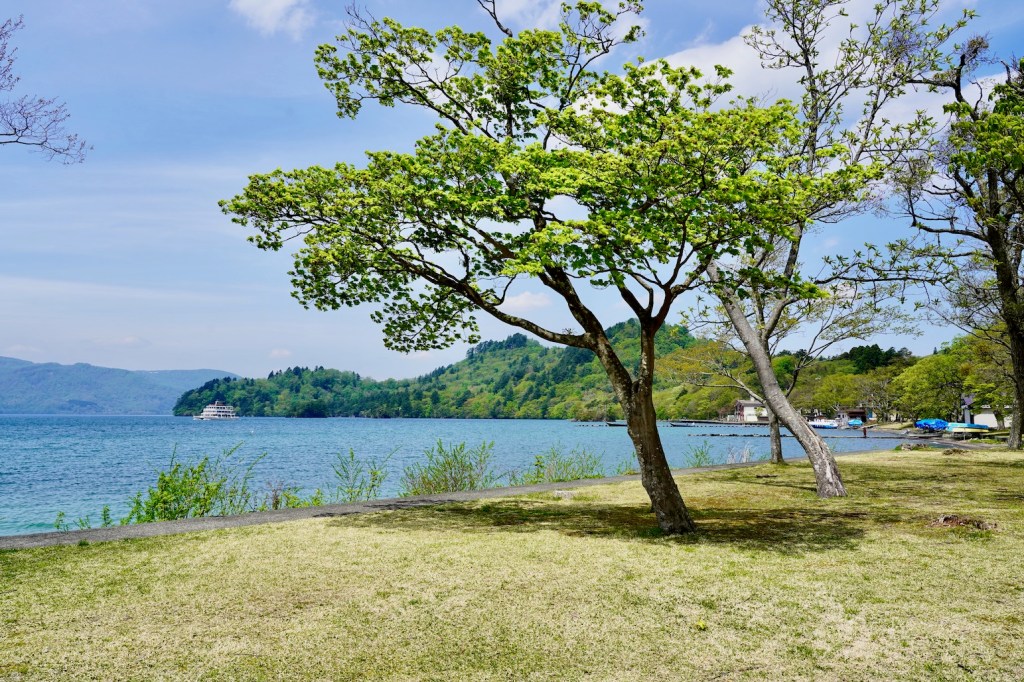
Lake Towada (十和田湖, Towada-ko) is the largest crater lake in Honshu. I hadn’t included it in our May itinerary as it seemed quite a long day trip from Aomori. Yet here we were, destined to see the Lake it seemed! We were lucky to get seats on the crowded second bus, and we were oblivious about the route ahead. A mystery tour!

The bus headed higher into the mountains, with the road becoming lined with small snow walls. It was very attractive country, and it was about to get much better! We presumed the Lake would be of interest. What we did not know was that the journey there would be one of the highlights of our May Japan trip.

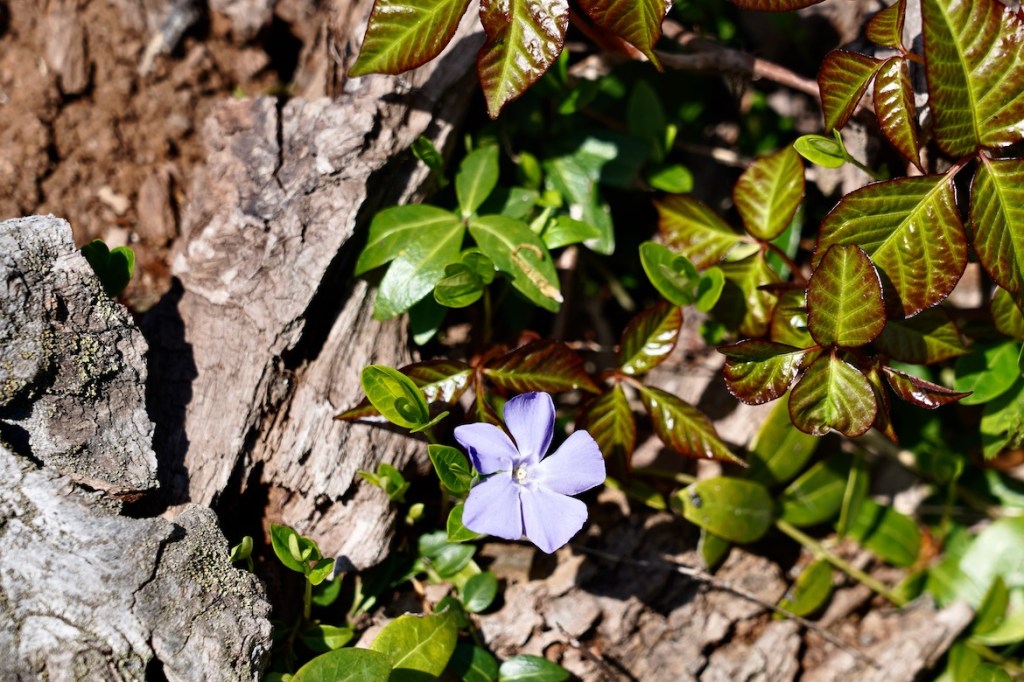
There were small accommodation villages in a few areas – and the bus made some stops where we stretched our legs and had a look round. The buildings were old style – nothing very modern – and the variety of flowers in their gardens interesting.


The magic begins
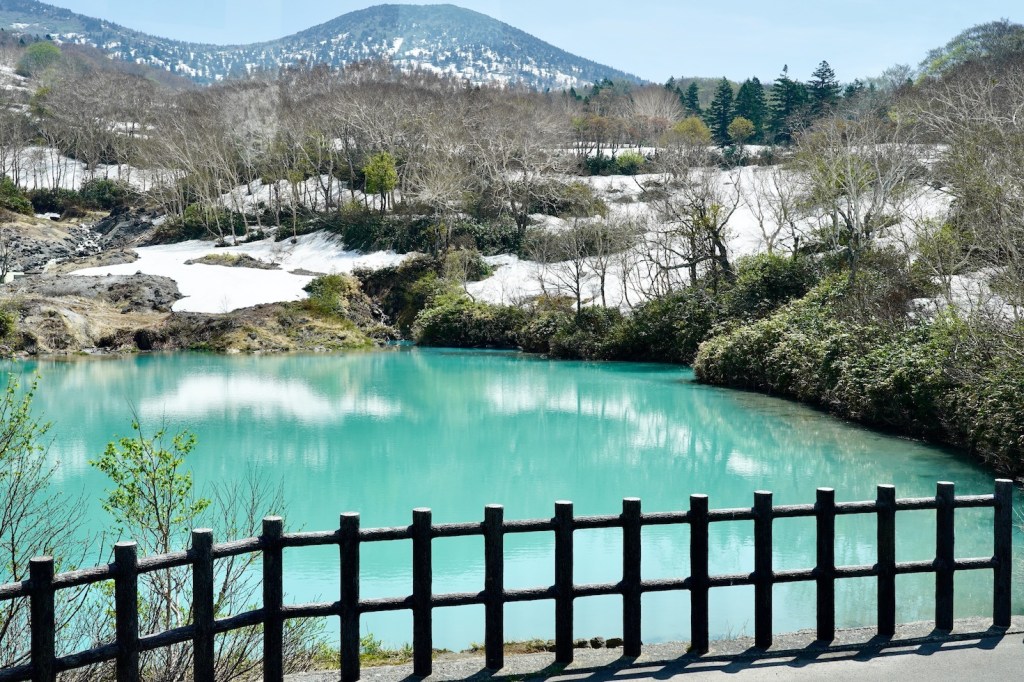
I think the real magic began to happen as we passed a small blue pond at one of the settlements en route. You know that feeling when you are unwrapping the layers around a gift. I had it then. I sensed the best was yet to come – and it did!
The bus began to descend into what I can best describe as an enchanting alpine rainforest valley. Beguiling, bewitching, captivating.
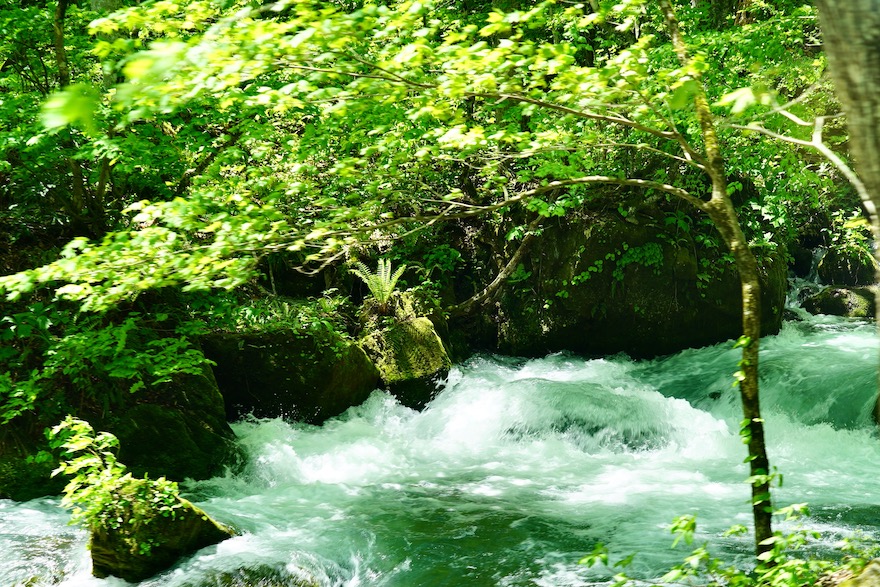
I now know we were travelling through the 14 kilometre long Oirase Gorge, featuring the exquisite Oirase mountain stream that runs for much its journey alongside the road – seemingly latched to it like a lifeline to this place of beauty.
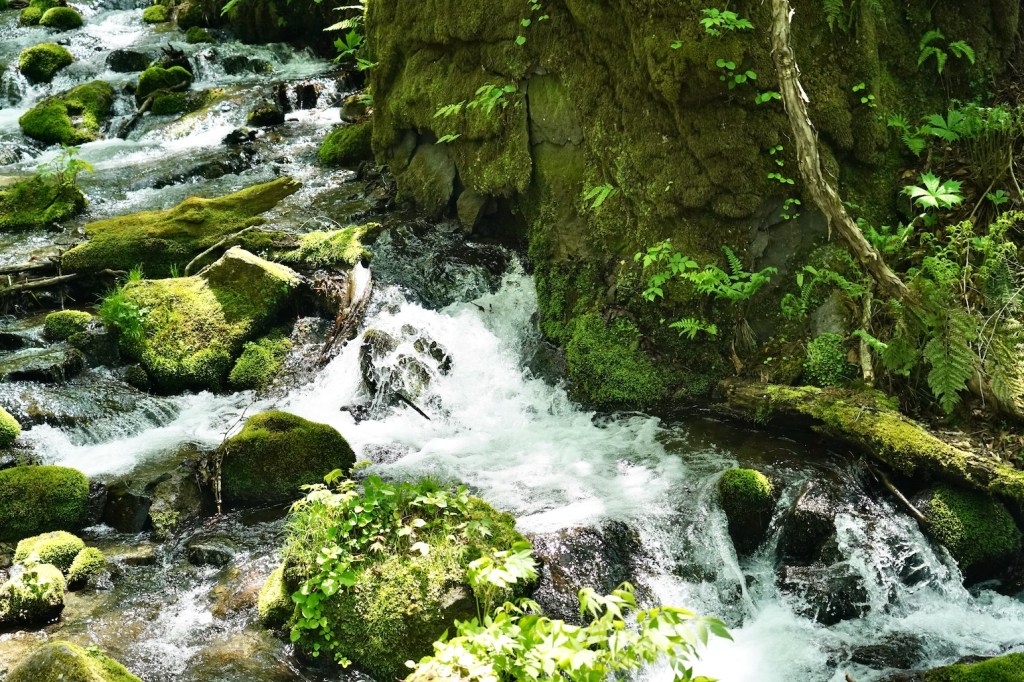
At some points it slowed down to create tranquil ponds. At others, fast flowing rapids, tumbled over moss covered rocks in its way. Twists and turns – the river is always beautiful. Apparently, there are more than 200 varieties of moss in the gorge, along with many varieties of ferns.


I was surprised to see so many people on walkways alongside the stream, crossing little bridges and heading to off shoot tracks to the many waterfalls in the Gorge. There are more than a dozen of them cascading down into the Oirase stream. From our bus, some waterfalls were clearly seen, others glimpsed through trees.


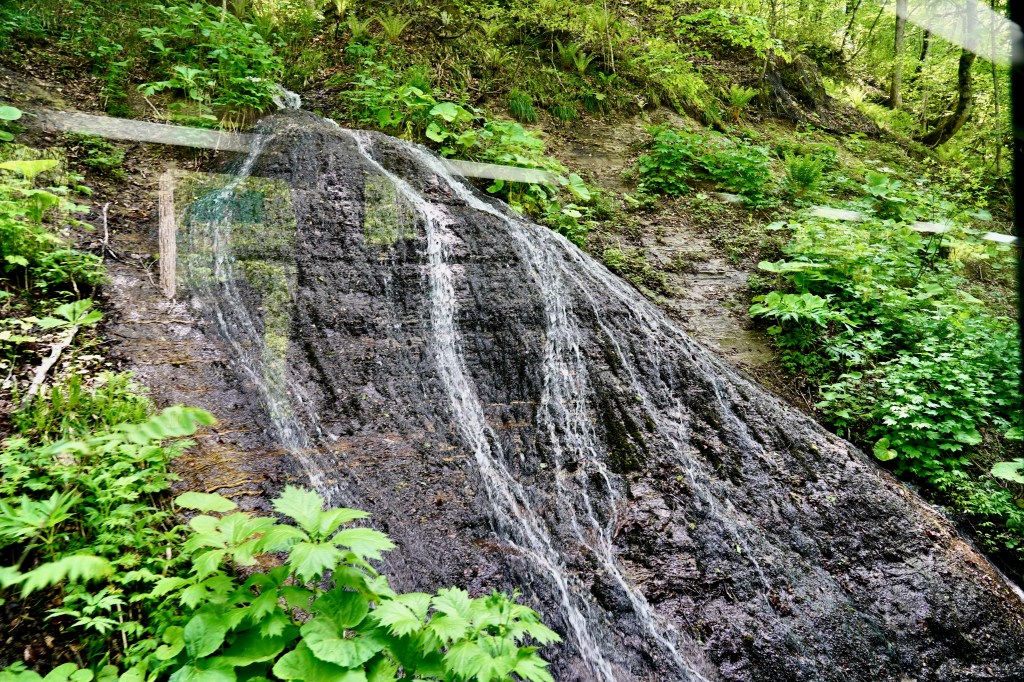
I longed to be out on the hiking trails too. Fortunately, the road is narrow and has a lot of bends. And then there were the people, walking and cycling. So the bus had to go slow, enabling me to capture some decent photos from my window.
Peak season apparently is in autumn when the forest is ablaze with gold, yellow and bronze colours. I suspect it would be super busy with visitors then, so May might be the best time!
I read later that a negative for the area is that the walking tracks and stream are so close to the road. For MJ and me, of course, it was a big plus as we were savouring our unexpected bus journey through it.
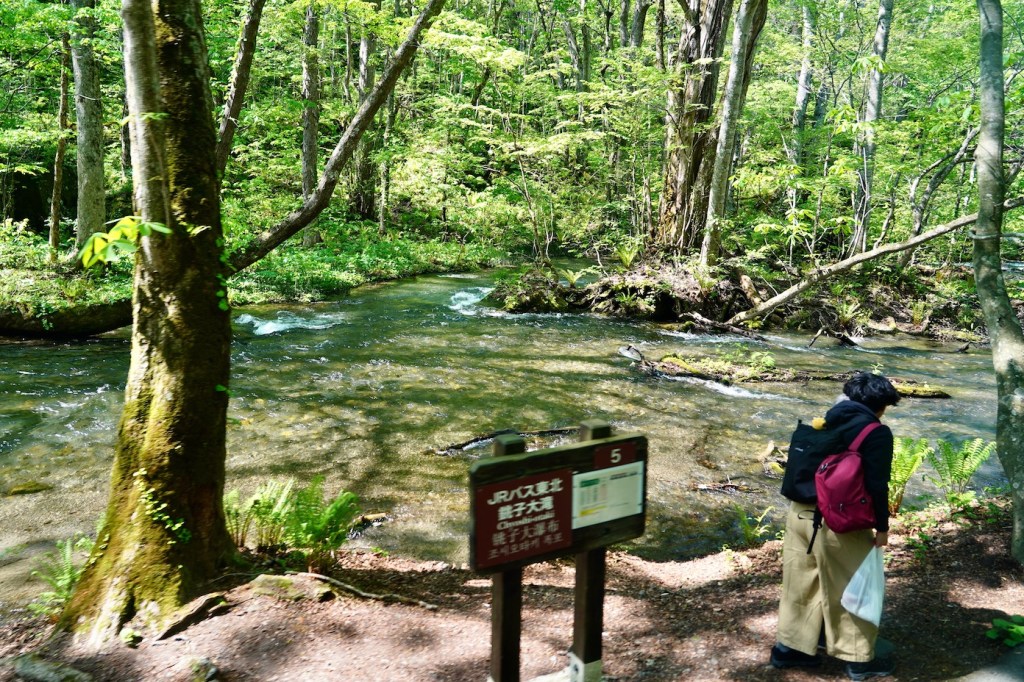

Apparently, the road can become so congested that authorities now close it to cars on certain days during the peak autumn season.
We reached the small town of Yasumiya on the shores of Lake Towada where we had a few hours to wander and have lunch. It was an overcast day, so the Lake wasn’t at its reputed best. But we enjoyed seeing it. There were cruise boats operating on the Lake, but we didn’t have enough time to go out on one. They were going out onto the Lake, fairly empty at this time of the year.

We decided on a restaurant near the Lakeside for a leisurely lunch. We chose one of those cook it yourself meals. Oishi! Delicious.
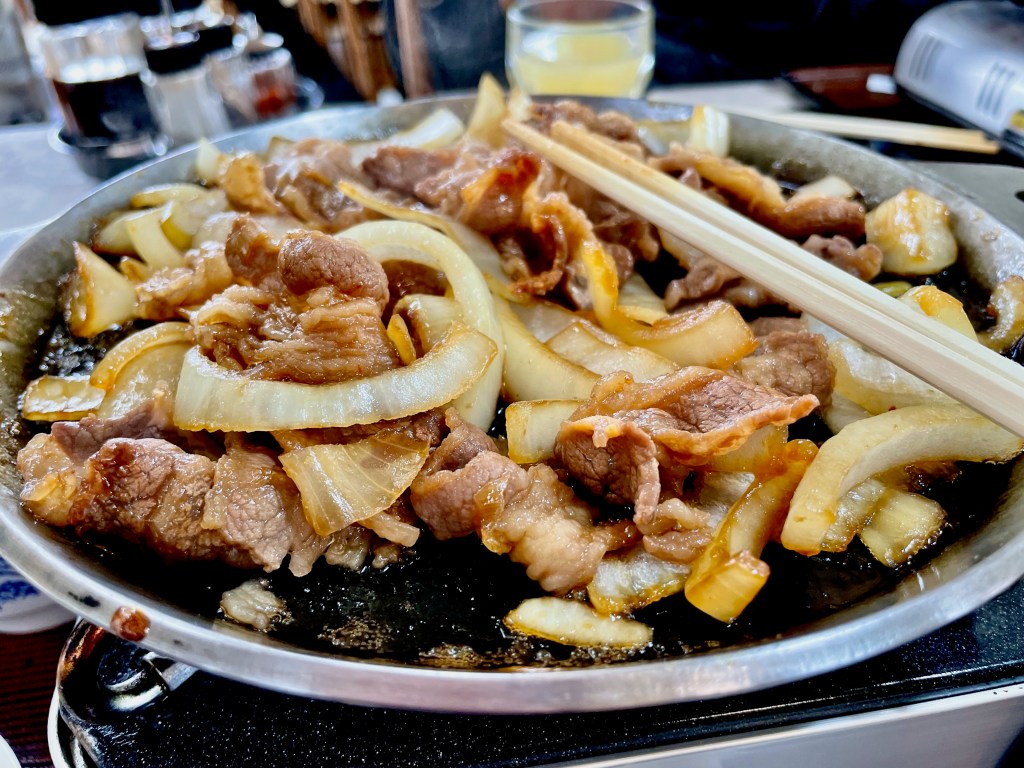
The town had a jaded air – as if it had passed its hey day. Though perhaps the peak seasons bring more life to it. We came across an excellent fine arts/crafts shop nearby where I bought a nice hand made pottery mug and some hand painted ceramic spoon rests. There were interesting old buildings, some fallen into disrepair – others being prepared for the summer season. Best of all, spring blossoms were still to be seen.


Finally, it was time for our return journey back to AOMORI. Now knowing of the magnificent scenery en route, we ensured we got seats offering better views and hopefully better photographic opportunities of what we had enjoyed on the journey to the Lake.
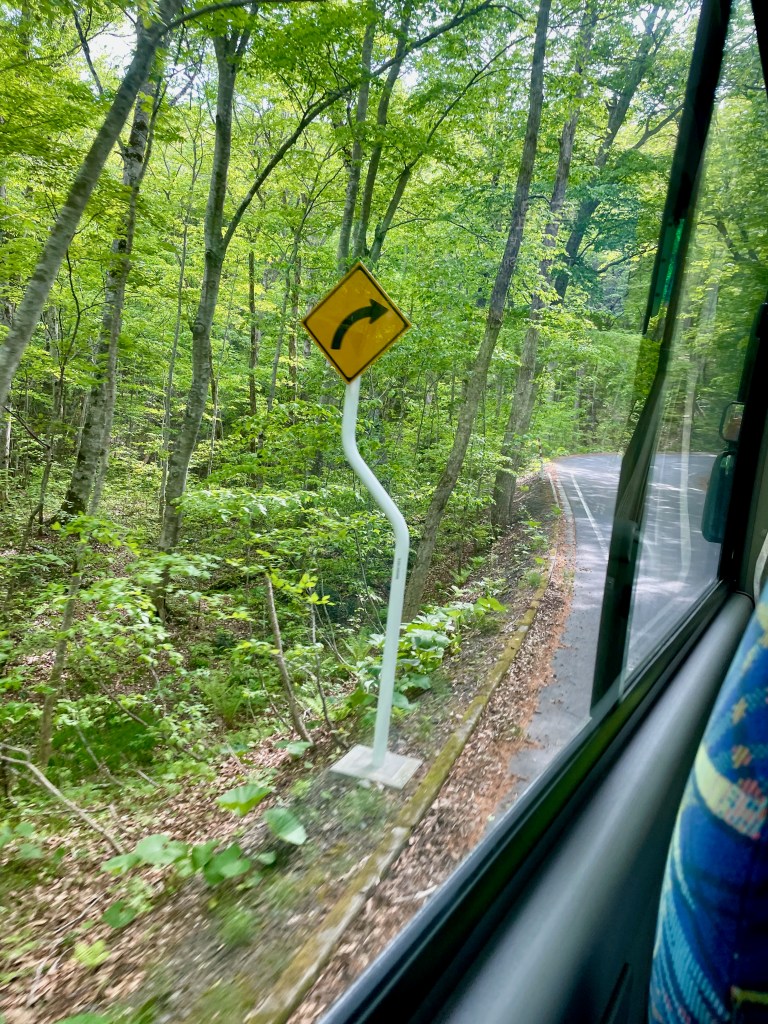

There wasn’t a moment of boredom. The journey was absorbing – and my only regret was that I hadn’t known before how beautiful the Oirase Stream area is! It is, in fact, a Japanese National Special Place of Scenic Beauty and National Natural Monument.

Luck brought me there, and hopefully luck will take me back one day when I can get out into the fresh air and walk some of the trails! That really would be magic (and my photos would be better LOL).

NOTE: On our return journey to Aomori, the bus stopped briefly at the Hakkoda Ropeway where three people, including a very elderly woman were waiting to board. But there was no room. The bus was packed, with no seats left. Already, two passengers were standing. So the trio was left, presumably to catch the final bus of the day a few hours later. Hopefully, there was room on it. I reflected that if we had stayed at the Ropeway, that would have been us. Stranded for even more hours! That would have made us truely ropeable!

NOTE: It was after I returned to Australia at the end of May 2025, that I learnt that one of the world’s worst mountain tragedies occurred in these beautiful mountains more than 120 years ago. In 1902, group of 210 Japanese soldiers preparing for war with Russia became lost in a winter blizzard in the Hakkoda mountains. Shockingly, 193 froze to death, six more died after rescue and eight of the eleven survivors had to have limbs amputated because of frost bite. It was the most lethal disaster in the world’s modern history of mountain climbing. Most of the men came from areas with little snow and lacked experience in climbing snowy mountains. They also did not use local guides.
A movie made during the 1970’s about the disaster is highlighted in an exhibition at the Aomori Forestry Museum. Read about my somewhat happier visit to the area in my story:
https://travellingtherese.com/2025/08/12/aomori-a-museum-that-needs-love/
 Travelling Therese
What a lucky twist of fate! Missing the ropeway led you to a breathtaking journey through Oirase Gorge and Lake Towada. Sometimes the best travel moments are the ones we don’t plan—thanks for sharing this hidden gem!
LikeLike
You are absolutely right – and I guess, the point of my story. We were so glad we saw it, even if it was just from the bus. Spectacular area. We had another twist of fate later in our trip when we accidentally boarded the wrong train and ended up unexpectedly in one of the worst hit areas by the 2011 tsunami. The city is reinventing itself as a manga city. That story coming up soon.
LikeLiked by 1 person
Wow, that sounds like another powerful and unexpected detour—can’t wait to read about it! It’s amazing how travel can take us from beauty to resilience in the span of a single journey. Looking forward to your next story!
LikeLike
Wow, gorgeous! It looks like some places here in Oregon.
LikeLike
Looked a lot like places in my home state of Tasmania. We have beautiful rainforests there, plus a lot of mountains/alpine areas. So I felt quite nostalgic. Most of my photos were taken from the moving bus – fortunately slow moving on the road – so I was pleased to get what I did. I would love to return and walk in the area.
LikeLiked by 1 person
[…] https://travellingtherese.com/2025/06/16/japan-magical-aomori-alpine-bus-ride/ […]
LikeLiked by 1 person
[…] https://travellingtherese.com/2025/06/16/japan-magical-aomori-alpine-bus-ride/ […]
LikeLike